How Expensive Greenwich Village Is
The ranking
In a 2014 ranking of home values, every one of the four Village ZIP codes was among the ten most expensive in the United States. This page gives the ranking only; it prints no housing figures, since they change every year and are not what a visitor pays.
Reason one: the landmark district
The city designated the Greenwich Village Historic District in 1969, covering more than 50 blocks, and extended it on 2 May 2006 and 22 June 2010. The South Village Historic District followed in 2013 with 235 buildings on 13 blocks, and the Gansevoort Market Historic District in 2003 with 112 buildings on 11 blocks. Protected streets keep their old buildings. The history page explains how the districts came about.
Reason two: low-rise, old houses
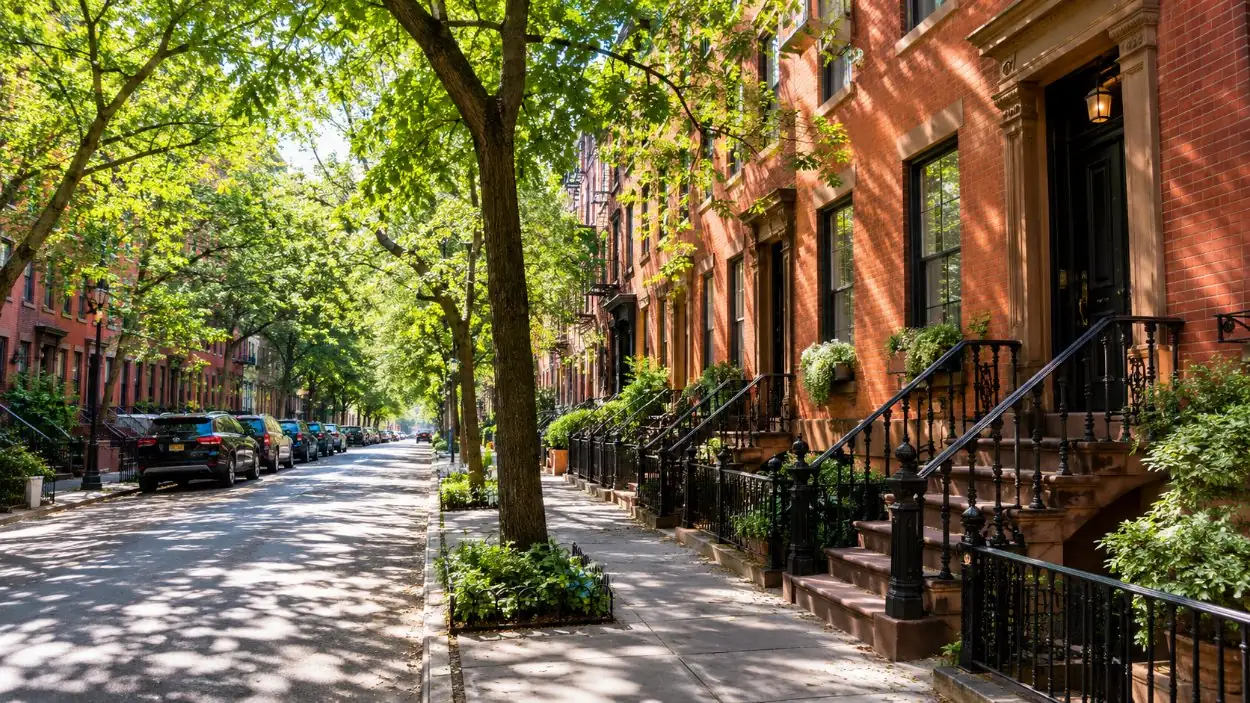
Much of the Village is low-rise row houses: the Isaacs-Hendricks House of 1799, Grove Court of 1854, the three-storey house at 75½ Bedford Street. Low buildings on protected blocks mean a limited number of homes in a place many people want to live.
Reason three: a small area
The whole neighbourhood covers about 0.29 square miles, bounded by 14th Street, Houston Street, Broadway and the Hudson. About 22,800 people live in the core. The bohemian era is over: the artists who gave the Village its name moved on to SoHo, Tribeca, Dumbo and Williamsburg, a shift the SoHo and nearby page touches on.
What a visitor pays for
Nothing, unless eating, drinking or booking. The streets, Washington Square Park, Christopher Park, the Stonewall visitor center and Jefferson Market Library are free. A slice, a falafel, a coffee or a club cover are the ordinary costs of a day. A guided walk is optional, and its current price shows in the booking widget; the cost page lists what each walk includes. A pay-what-you-wish walk or the self-guided route costs nothing at booking.
| Item | Charge |
|---|---|
| Walking the streets | None |
| Washington Square Park | None, 6 am to midnight |
| Stonewall visitor center | None |
| Jefferson Market Library | None, a public library |
| Food and drink | At each counter |
| Guided walk | Live in the booking widget |
Several of the free places carry the Village’s history on their own: the arch of 1892, the Brown Building of the 1911 fire, and Christopher Park with its sculpture of 1992.
What the district protects
The landmark districts keep more than facades. They hold the 18th-century street pattern that the 1811 grid never reached, the Federal row houses of Bedford Street, the gated court of 1854 on Grove Street and the 235 buildings of the South Village district. The wider area counted 66,880 people in the 2010 census.
Where the bohemians went
The Village was once a byword for bohemia: the Tenth Street Studio Building of 1857, the speakeasy at Chumley’s, Cafe Society at 1 Sheridan Square. The studio building was demolished in 1956, and the artists moved on to SoHo, Tribeca, Dumbo and Williamsburg. What remains is the housing they lived in, which the 2014 ranking placed among the most expensive in the country.
The food walks include their tastings, and the four-neighbourhood walk includes food, drinks and gratuities, so the meal is part of the booking on those three.
Frequently asked questions
Is Greenwich Village an expensive place to live?
Yes, by ranking: in 2014 all four Village ZIP codes were among the ten most expensive in the United States by median housing price.
Is Greenwich Village expensive to visit?
No charge applies to the streets, the park or the Stonewall visitor center. See the cost page for the walks.
Why is housing in Greenwich Village so costly?
A landmark district since 1969 keeps the low-rise row houses, and the area is small. The history page covers the districts.