The Best Streets in Greenwich Village
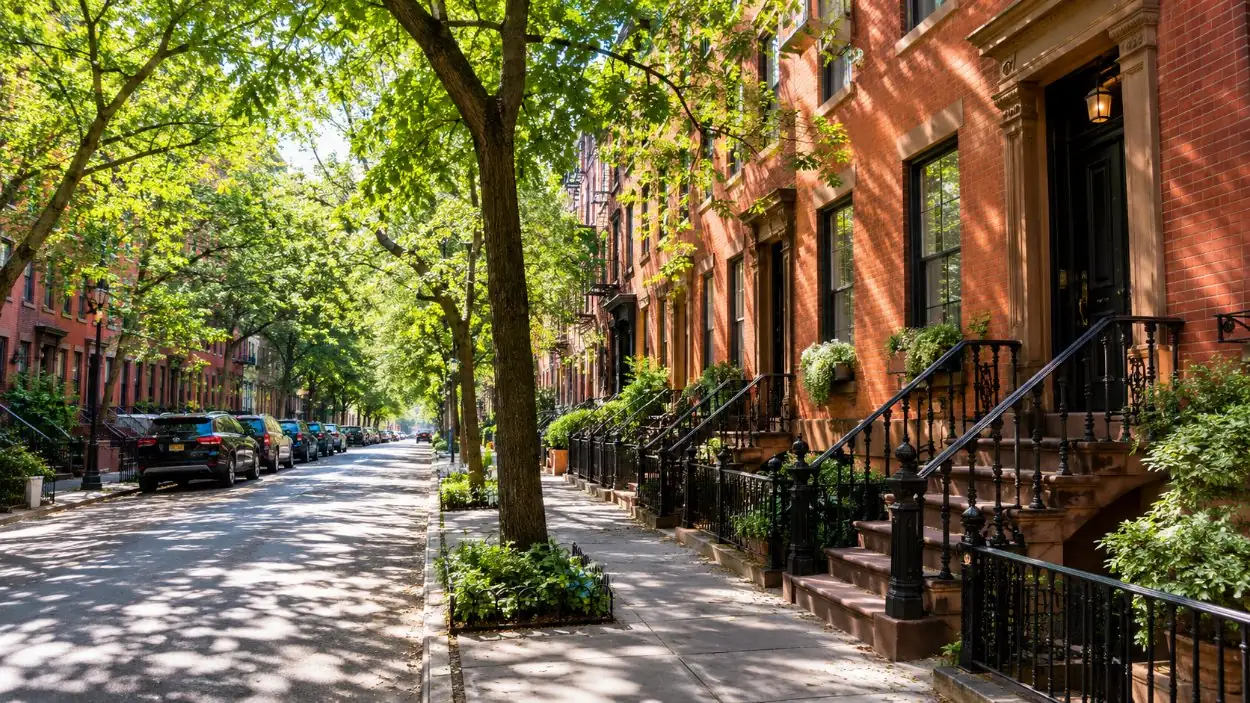
Why the streets bend
The Commissioners’ Plan of 1811 laid numbered streets over Manhattan, but the Village was already built, so it kept its own pattern. West 4th Street, which runs east-west elsewhere, runs north-south here and crosses West 10th, 11th and 12th Streets. It follows old Asylum Street; Amos Street became West 10th, Hammond Street West 11th and Troy Street West 12th. The street grid page has the full story.
MacDougal Street
The street of cafés and basement clubs south of the park: Caffe Reggio at 119 (1927), the Comedy Cellar at 117, Cafe Wha? at 115, and Mamoun’s falafel, open since 1971. “Inside Llewyn Davis” recreated its folk scene of 1961.
Bleecker Street
Near MacDougal, the 1960s clubs: The Bitter End at 147 is still open. Further west, Faicco’s (since 1900), Murray’s Cheese at 254 (since 1940), John’s of Bleecker Street (1929) and Magnolia Bakery at 401. West of Seventh Avenue the shopfronts turn to boutiques.
Bedford Street
Chumley’s behind its unmarked door at 86, the “Friends” exterior at 90, the Isaacs-Hendricks House of 1799 at 77 and the narrowest house in Manhattan at 75½, where Edna St. Vincent Millay lived in 1923–24.
Grove Street and Commerce Street
Grove Court, six row houses of 1854 behind a gate between 10 and 12 Grove Street. Round the corner, the Cherry Lane Theatre at 38 Commerce Street, founded 1924.
Christopher Street
The Stonewall Inn at 53, the visitor center at 51 and Christopher Park, part of the Stonewall National Monument. The Stonewall page covers 1969.
Washington Square North
The row facing the park, where Edward Hopper lived and worked at number 3 from 1913 to 1967. Washington Mews runs behind it. More names are on the famous residents page.
Gay Street and Minetta Lane
Gay Street curves for one block between Christopher Street and Waverly Place; the name is an 18th-century family name, older than the modern sense. Minetta Lane and Minetta Street carry the name of Minetta Creek, which once ran through the ground that became Washington Square Park; “Serpico” filmed on Minetta Street in 1973.
Where the shops and cafés cluster
Cafés and small restaurants gather on MacDougal, delis and pizza counters on Bleecker between Sixth and Seventh Avenues, and boutiques on Bleecker west of Seventh Avenue. The food page lists the counters by name.
Hudson Street and Perry Street
Hudson Street marks the start of the Far West Village. The White Horse Tavern has stood at 567 since 1880, and Jane Jacobs lived at 555. Perry Street holds the stoop at 64/66 used in “Sex and the City”, a private house with a chain across the steps.
Jones Street, Carmine Street and St Luke’s Place
The cover of “The Freewheelin’ Bob Dylan” (1963) was shot on Jones Street, off West 4th. Carmine Street has Joe’s Pizza (1975) and the church of Our Lady of Pompeii (1928). St Luke’s Place holds the screen houses of “The Cosby Show” at 10 and “Wait Until Dark” at 4.
Bedford, Grove and Commerce Streets meet within a few blocks, so the row houses, Grove Court and the Cherry Lane Theatre fit into one short loop.
Frequently asked questions
Which is the most famous street in Greenwich Village?
MacDougal and Bleecker Streets for the 1960s music, Christopher Street for Stonewall, and Bedford Street for the row houses and the narrowest house in Manhattan.
Where are the shops in Greenwich Village?
Boutiques cluster on Bleecker Street west of Seventh Avenue; delis and cafés on Bleecker and MacDougal. See the food page.
Why do Greenwich Village streets not follow the grid?
The Village was built up before the 1811 plan and kept its older pattern. The street grid page explains.