A History of Greenwich Village
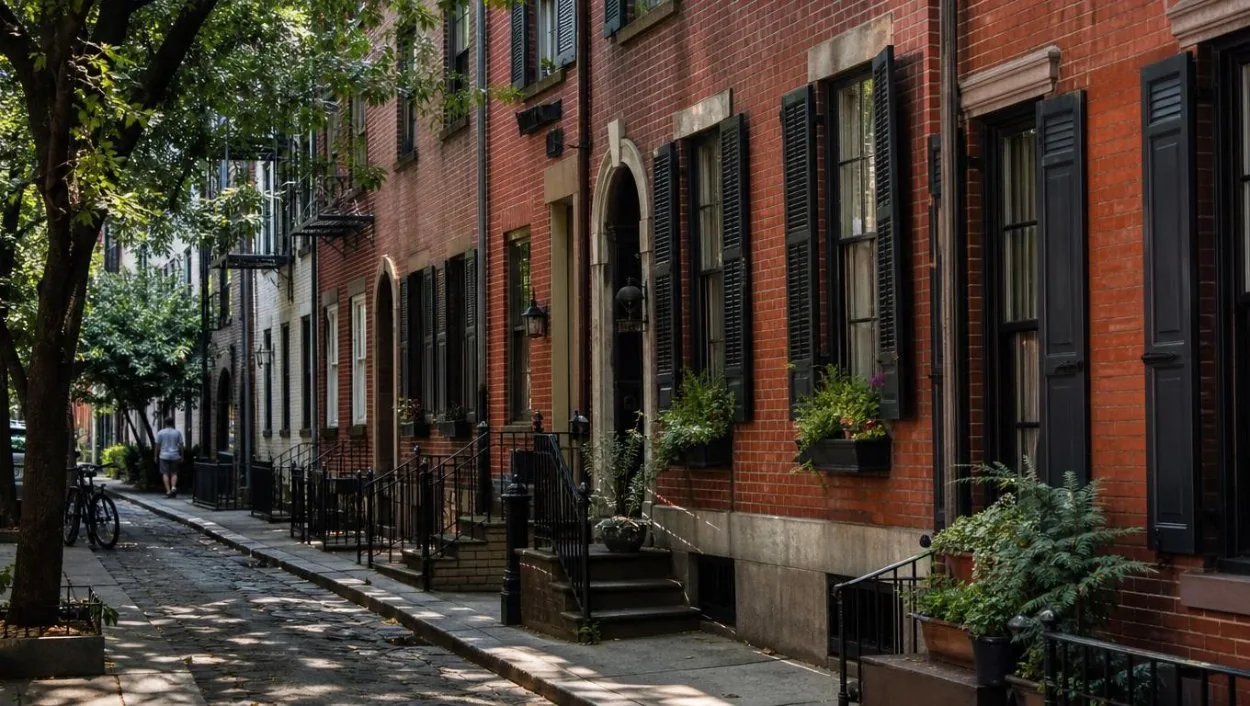
Lenape, Dutch and English
The Lenape called the north-west corner Sapokanikan, “tobacco field”. The Dutch settlement was Noortwyck. In 1644 eleven formerly enslaved Africans received “half freedoms” and parcels of land here. The name comes from the Dutch Groenwijck, and the earliest reference to “Greenwich” dates from 1696.
Prison, burial ground, fever
Newgate Prison stood at West 10th Street and the river from 1797 to 1829. From 1797 to 1825 the ground that became Washington Square Park was a potter’s field. The Commissioners’ Plan of 1811 laid numbered streets over Manhattan, but the Village was already built, so it kept its own pattern; the street grid page explains the result. In 1822 a yellow fever epidemic drove New Yorkers north out of the city into the Village, and many stayed.
The 19th-century Village
The Church of the Ascension went up on Fifth Avenue in 1841. Henry James was born on Washington Place in 1843, and Poe lived on West 3rd Street in 1845. Grove Court was built in 1854 and the Tenth Street Studio Building in 1857. Jefferson Market opened as a courthouse in 1877, and Stanford White’s arch rose in 1892.
1911: the Triangle fire
On 25 March 1911, at 4:40 pm, fire broke out on the eighth floor of the Asch Building, now the Brown Building, where the Triangle Waist Company occupied floors 8 to 10. The exit doors were locked. 146 people died, 123 women and girls and 23 men, mostly Italian and Jewish immigrants aged 14 to 23. New York State passed 38 new labour laws between 1911 and 1913. The Brown Building page has the details.
Bohemia
Chumley’s served Faulkner, Steinbeck, O’Neill and Fitzgerald as a speakeasy in the 1920s. The Cherry Lane Theatre opened in 1924, Caffe Reggio in 1927, and Mae West was tried at Jefferson Market’s women’s court in 1927. Cafe Society at 1 Sheridan Square opened in 1938 as the first racially integrated nightclub in the United States, and Billie Holiday first sang “Strange Fruit” there in 1939.
The folk years and the fight for the park
Residents led by Shirley Hayes stopped Robert Moses’s road through Washington Square; the park closed to traffic completely by August 1959. Bob Dylan arrived in January 1961, the “Beatnik Riot” over folk singers’ permits followed on 9 April, and Jane Jacobs published “The Death and Life of Great American Cities” the same year. Residents saved Jefferson Market, which reopened as a library in 1967.
1969 and after
In 1969 the city designated the Greenwich Village Historic District, more than 50 blocks, and in the early hours of 28 June the police raid on the Stonewall Inn set off the uprising. The first Pride march followed in 1970, the year of the Weather Underground townhouse explosion at 18 West 11th Street and Electric Lady Studios opened. The district was extended in 2006 and 2010; the South Village district followed in 2013 and the Stonewall National Monument in 2016. Village Preservation documents the landmarking on villagepreservation.org.
Today
The bohemian era is over; the artists moved on to SoHo, Tribeca, Dumbo and Williamsburg. About 22,800 people live in the core. The two-hour history walk and the four-neighbourhood walk tell this story on foot; the history walks page compares them.
The Brown Building and the Stonewall Inn are both stops on the history walk and the ghost walk, so either one covers 1911 and 1969.
Frequently asked questions
Why is Greenwich Village famous?
For the 1911 Triangle fire, the bohemian and folk eras, the Stonewall uprising of 1969 and a street plan older than Manhattan’s grid.
Where does the name Greenwich Village come from?
From the Dutch Groenwijck, “green district”. The earliest reference to “Greenwich” dates from 1696.
When did Greenwich Village become a historic district?
In 1969, covering more than 50 blocks, extended in 2006 and 2010. The Stonewall page covers the same year’s uprising.